Last Sunday, I ran the 2025 Seattle Marathon. This was my third marathon, and I got a PR! I’m splitting this race report into two broad sections: about the course, and about my experience/training/etc.
The Course & Event
Candidly, I’ve avoided running the Seattle Marathon in the past because I’d heard negative things about the course layout. Previous courses spent much more time around the arboretum and University District, and routed over the 520 bridge – which does sound fun in the abstract1, but would be monotonous for a race.
One thing I still grumble about with the Seattle Marathon is that they do not post their courses until a few months before the race. This is in contrast with other races, which either don’t meaningfully change their courses year-over-year, or have an established course prior to registration opening. Signing up for a course sight-unseen isn’t great.
However, the 2025 course was great! It was a true highlight reel of the best locations for Seattle running.
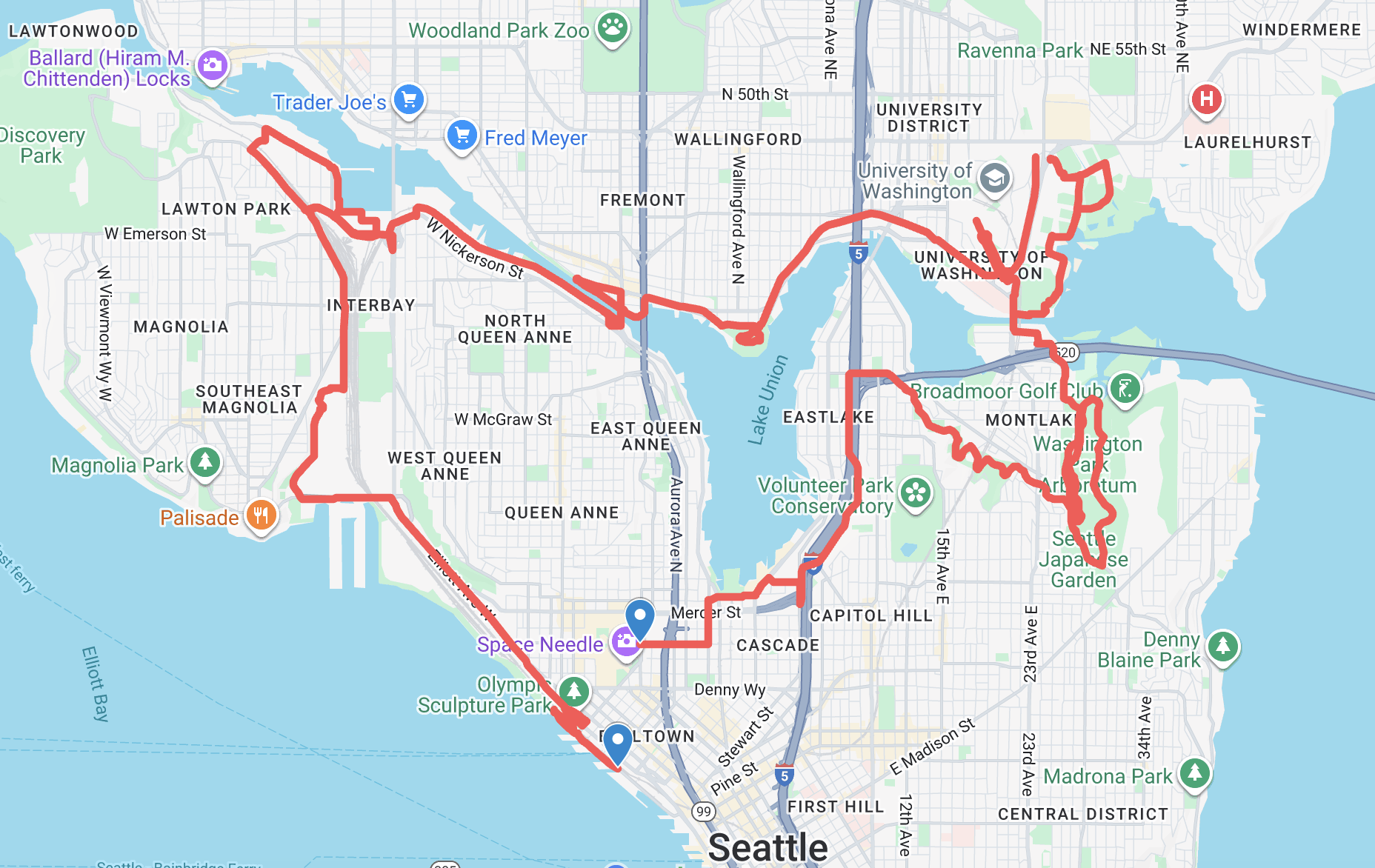
Course Map: 2025 Seattle Marathon
Broadly, the course started near the Gate Foundation building, went up through Eastlake, turned east to the Arboretum via Interlaken park, provided a nice loop through the Arboretum and the University of Washington Campus, then headed west through Gasworks park, Fremont, the Fremont Canal, and Interbay.
Interlaken Park, Arboretum, Union Bay Natural Area
The section of the course that went through Interlaken Park, the UW Arboretum, and the Union Bay Natural Area (near Husky Stadium) was the highlight of the race for me. Running through those parks on a crisp day as the sun is coming out, alongside a ton of other runners… amazing.
Magnolia & Interbay
In contrast, the hilly industrial streets north of Interbay and the section of Elliott Ave in the last 3 miles of the course are not that nice to run on.
The last several miles were a point of contention, since they caused significant traffic in Magnolia and largely prevented residents from leaving during the race. When I normally run this section of Interbay, take the Elliott Bay Trail past through the industrial area there, which connects to Centennial Park. (This is the blue route in the map.)
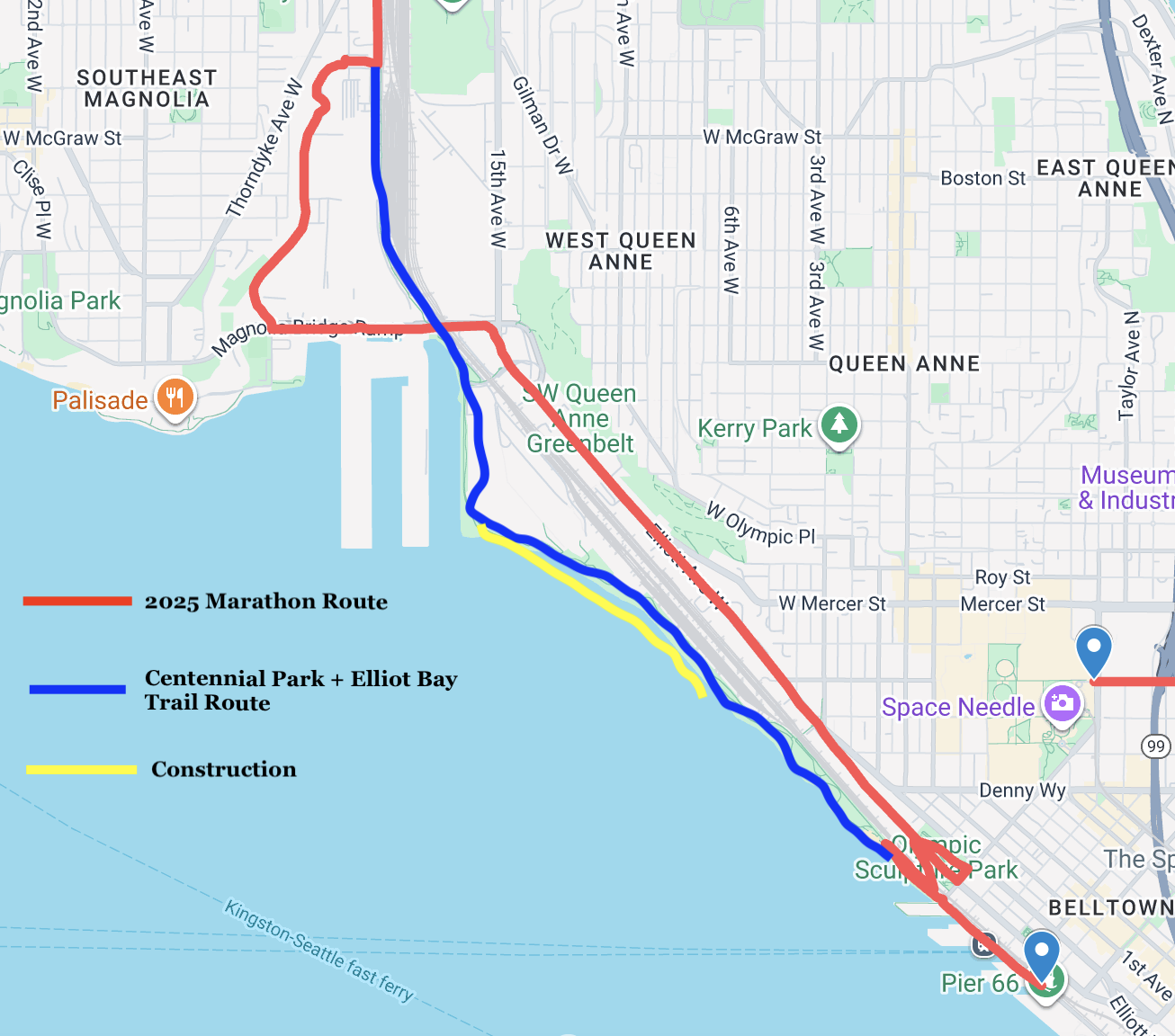
Course Map: Magnolia Bridge & Elliott Way Segment
I think this would have been the preferred route by the marathon planners, but there are two things preventing this route from actually being used:
- Despite recent trail renovations, there’s still a significant choke point in the trail in the connection between the Elliott Bay Trail and Centennial Park that would likely have been a safety issue for the volume of marathon runners.
- There is ongoing construction in Elliott Bay Park that would make it tricky to route through.
I have pretty high confidence in this second factor, as this message was posted around the Race Expo:
The new courses touch several parks, waterways and other viewpoints throughout the city, showcasing the beauty of all of Seattle.
And next year the courses get even prettier! Starting in 2026, once construction of the Elliott Bay Trail has been completed, we have agreements to switch the last two miles of the races from Elliott Ave to the brand new waterfront trail.
As an alternative to the nicer Elliott Bay trail, the course instead routed over the Magnolia Bridge, which caused significant traffic. My sense though is that this wasn’t the “first choice” for the course, as (if memory serves) the course was updated a few times after it was announced.
Turnarounds & Loops
The other gripe I had with the course was that it relied more on turnarounds than I would have preferred. As a Seattle-native runner, this didn’t bother me too much; I was quite familiar with the course and the turnarounds felt logical enough. If I were coming from out of town, this likely would have been more annoying.
The one really unfortunate course element though was, again, north of Interbay. At the intersection after the Emerson Pl Bridge, the course wanted you to first turn right to do a loop up Gilman Ave, then drop back to Fishermans Terminal via Commodore Way. Then you go over the Emerson Pl Bridge again, this time turning left and going down to Interbay.
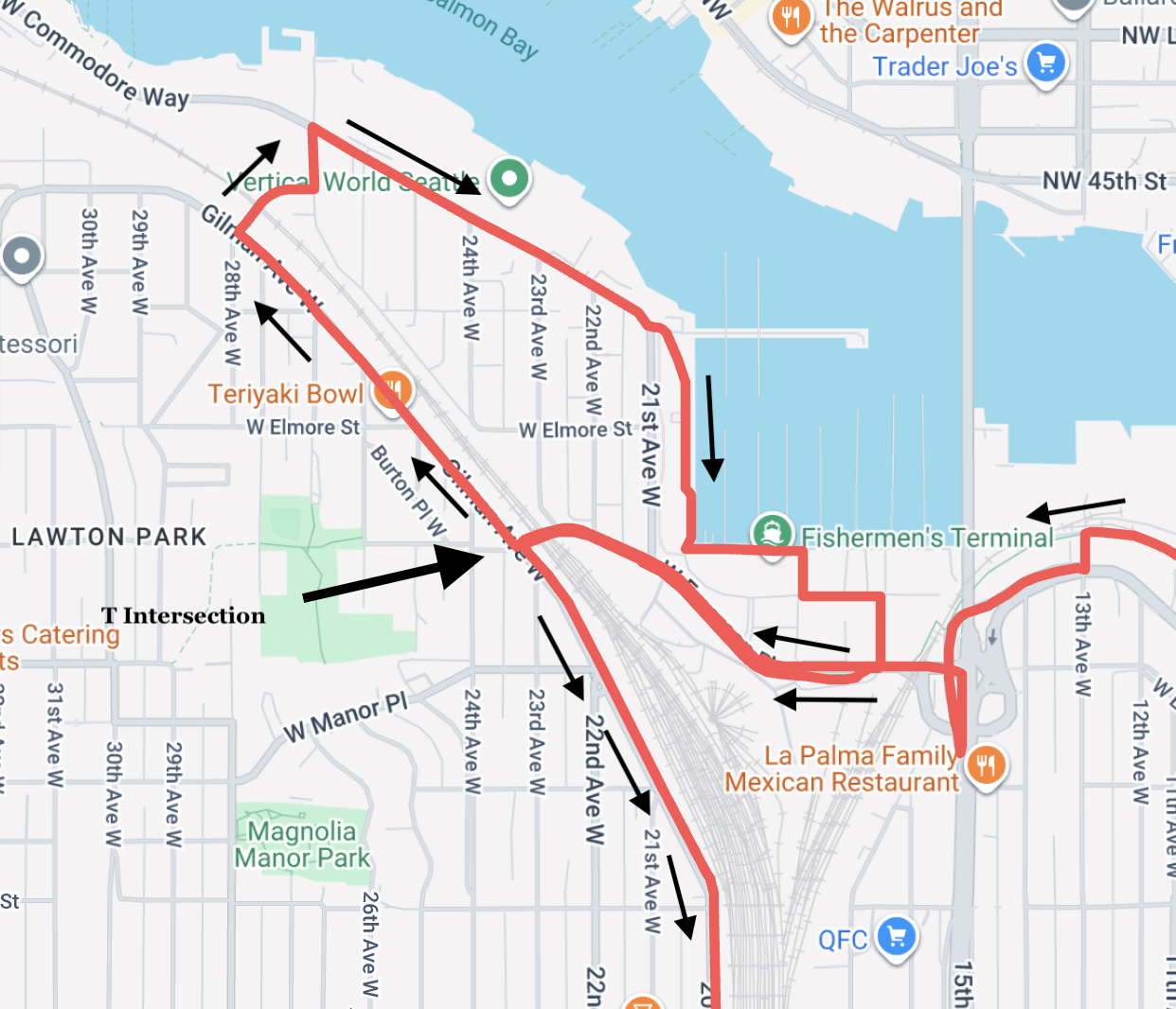
Course Map: Interbay Loop
Having seen the course online and knowing the area well, this was reasonably intuitive. However, I saw at least a dozen runners who’d taken the left on their first pass and had to retrace their steps (sometimes for >1 mi) to do the loop they’d accidentally skipped. There were course monitors at the interaction, but the signage was still evidently insufficient.
Summary
Overall I enjoyed the course quite a bit. The event management was really good: the race started on time, the aid stations were plentiful/well-staffed, and the finish line was on-par for post-race chaos. I think if they smooth out the Interbay/Magnolia piece next year, this same course would be an excellent one to repeat.
My Experience
TL;DR: I finished in 3:24:34, a PR, down from my previous best, which was ~3:43.
Training
My training window for this race was rather long. I’d been ”training” for months longer than I needed to, to partially train alongside a friend who ran the San Francisco Marathon in late July. My training started in earnest shortly after that, and I used Runna for the first time to manage my plan.2
My training was mostly uneventful, until near the end. I’ll write more about Runna at some point, but in short: it was really helpful in scheduling progressive long runs, and I loved that is generated pace workouts which helpfully sync to your running watch. I built up my weekly volume and distance capacity without issue.
However. In early November, I injured myself on a 20mi long-run. I started the run feeling like something was “off” in my knee, but kept running on it. The whole run was slow and painful, and it was the first time in my entire running experience that I was unable to walk after a run. Not great. I took a week off after that and wore a knee brace consistently until race day. Eventually, my knee improved, but the ankle on the same leg got injured too – potentially compensatorily. So I started wearing a compression brace on that ankle too.
I was becoming pessimistic that I’d actually run the race, since I didn’t want to further injure myself and had to dramatically step down my training in the final month – skipping all my tempo runs, and limiting the distance of my last long runs to well under the plan.
In a moment of injury reprieve mixed with inspired consumerism, I bought a pair of carbon “super shoes”: Adidas Adios Pro 43s. The first time I put them on to go out and test them, I ended up running my first ever sub-20min 5k. Was this a good idea? Probably not, but surprisingly it didn’t aggravate my knee and was a strong mental win.
Race Day
Pace groups: I ran the first 18-19 miles with the 3:20 pace group, which went really well. That helped a lot with not going too fast out of the gate. In my first two races, I had the tendency to run really fast at the beginning and burn out around mile 13, then struggle from 13-20, and be in a bad situation from 20-26. Running with a pace group got me solidly to mile 18 without overexertion, but still at my goal pace.
Fueling My fueling was definitely suboptimal. I brought 3 protein bars and a caffeinated Verb bar with me. Unfortunately I somehow “lost” two of the bars I brought in the bottom of my running vest, and didn’t want to stop to fish my backup out of the bottom of my vest. The result of this was I ended up having a bunch of course gels. This was fine, but I got “sweeted out” and had this sickly sweet feeling in my mouth from mile 18 on.
Shoes: Shoes wise, running with carbon shoes definitely helped, but more in the early sections where my legs were fresher. Qualitatively, I feel like they probably gave me a 30 second qualitative boost on my pace, which is nontrivial. However, the last 6-8 miles was still pretty hard. My thighs started freezing up which makes maintaining a sub-8:30 pace tricky. The Adios shoes have much less stability than my usual Brooks Adrenalines, which led to a few close calls with rolling an ankle as my legs fatigued.
The Last 6mi: The phrase “a marathon is a 20mi warmup to a 6mi race” is popular for a reason:4
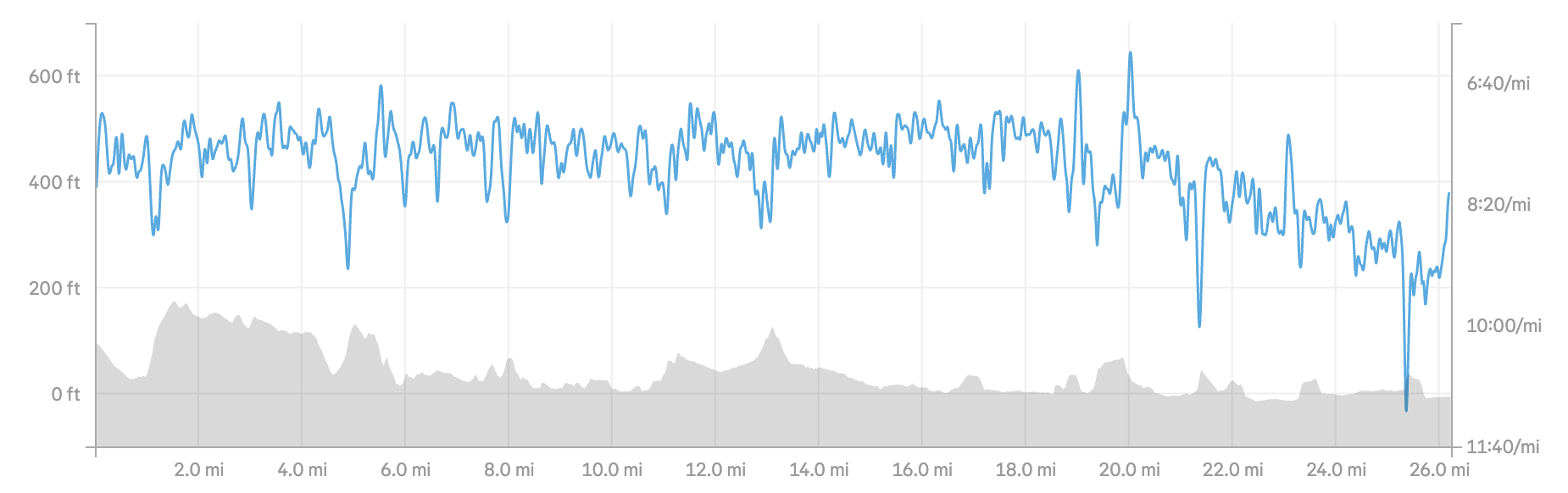
My pace chart for the race
Finishing & Post Race: Marathons are such a mental game. In the last mile or two, I had the feeling that I could push myself to finish a few seconds faster, but ultimately decided to not to. Once I was confident that I’d finish comfortably under 3:30, I “just” wanted to finish without further degrading my form. This probably was a smart decision. As I stopped in the finish corral, I had a few seconds of post-run adrenaline, which immediately crashed into “yup, can’t really walk anymore”. It was also still a quite cold day, and so I got to use one of those fun mylar blankets for the first time.
Pictures
Start Line Union Bay Natural Area 520 Bridge Almost at the Finish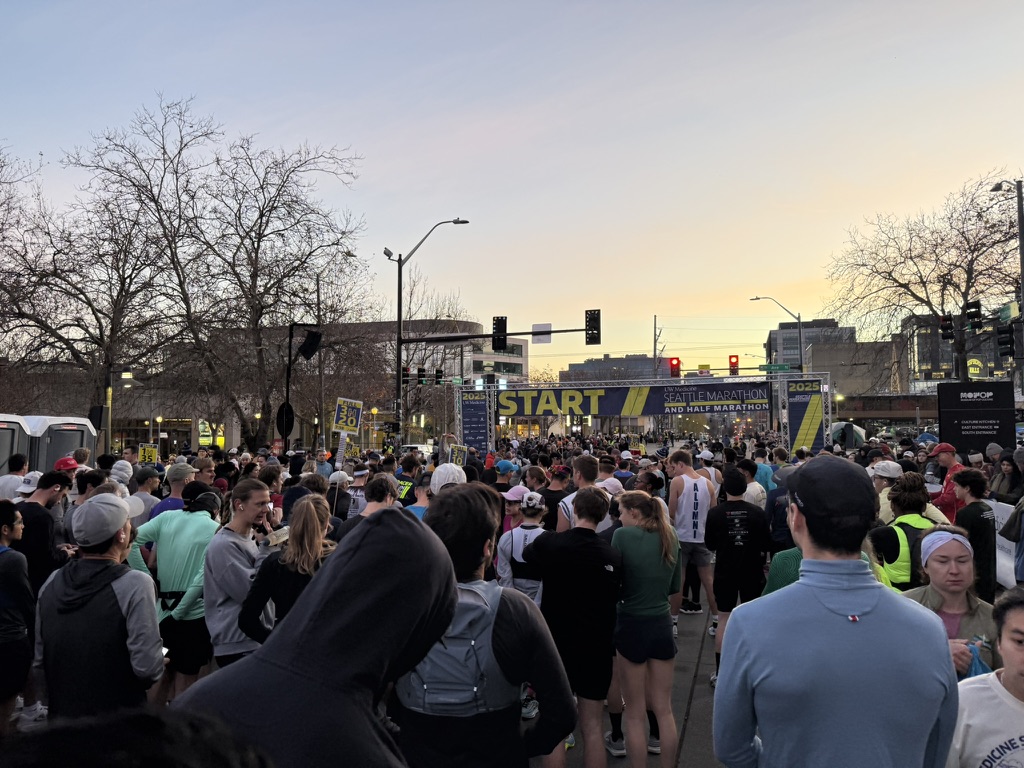
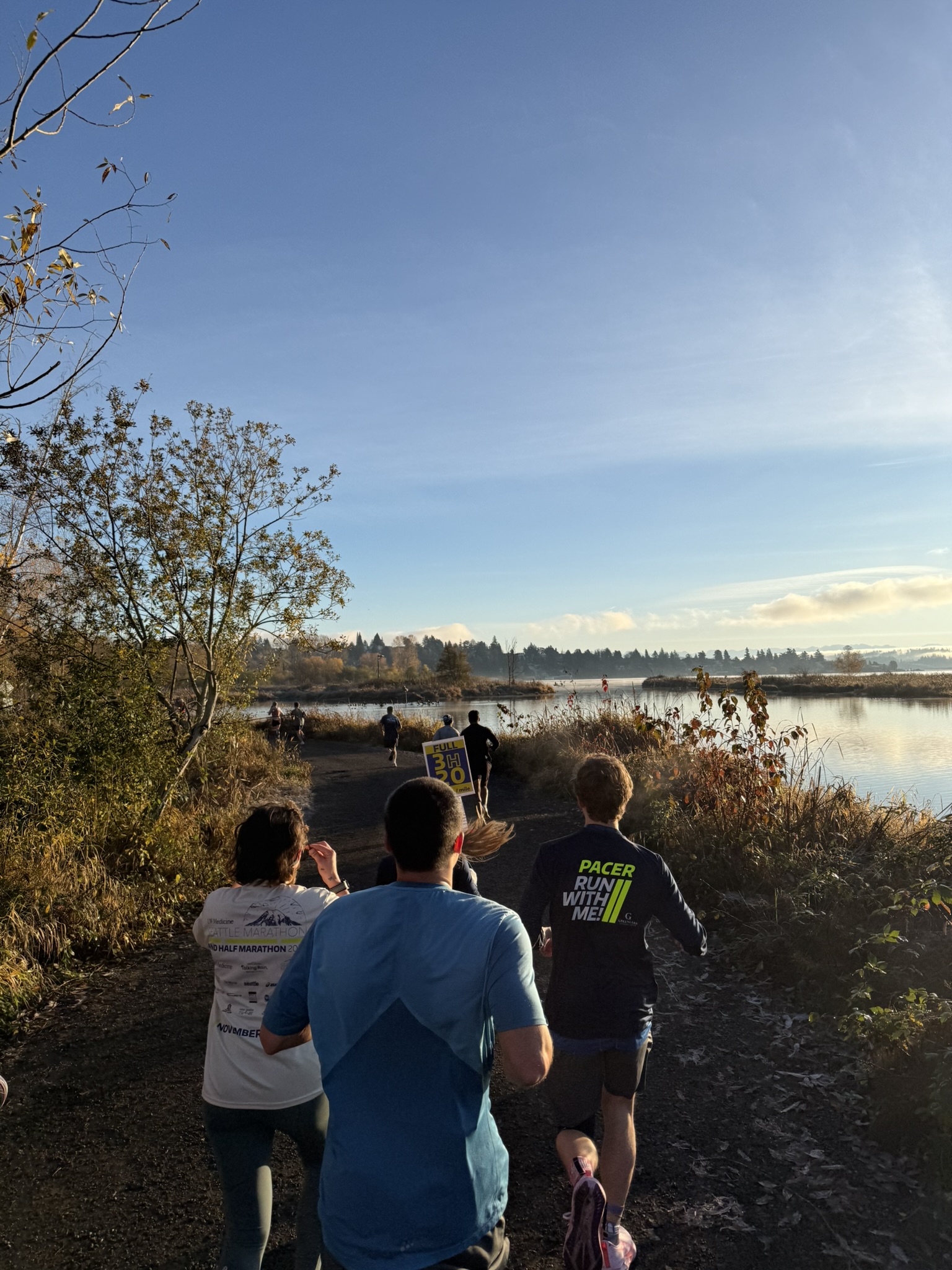
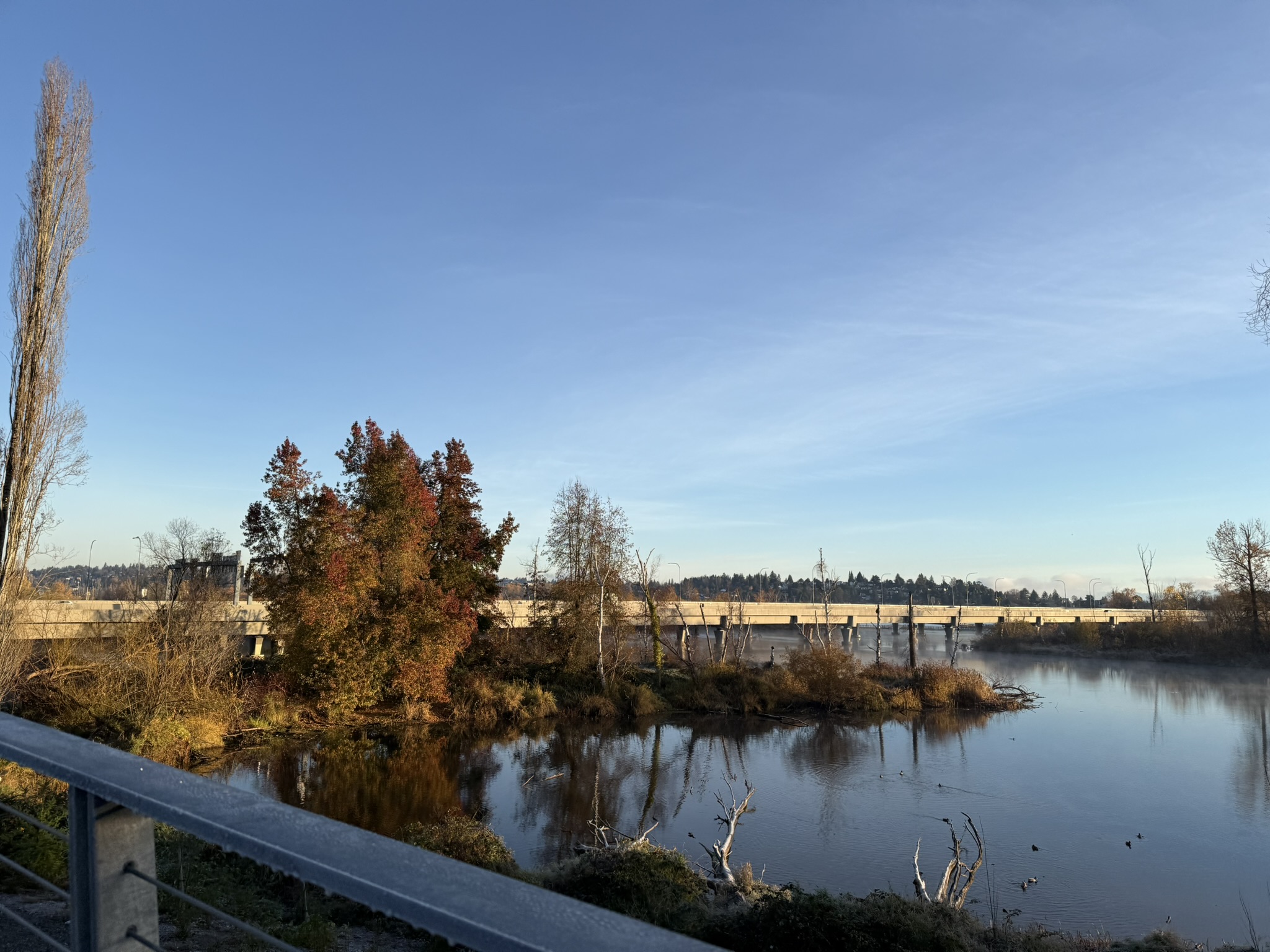
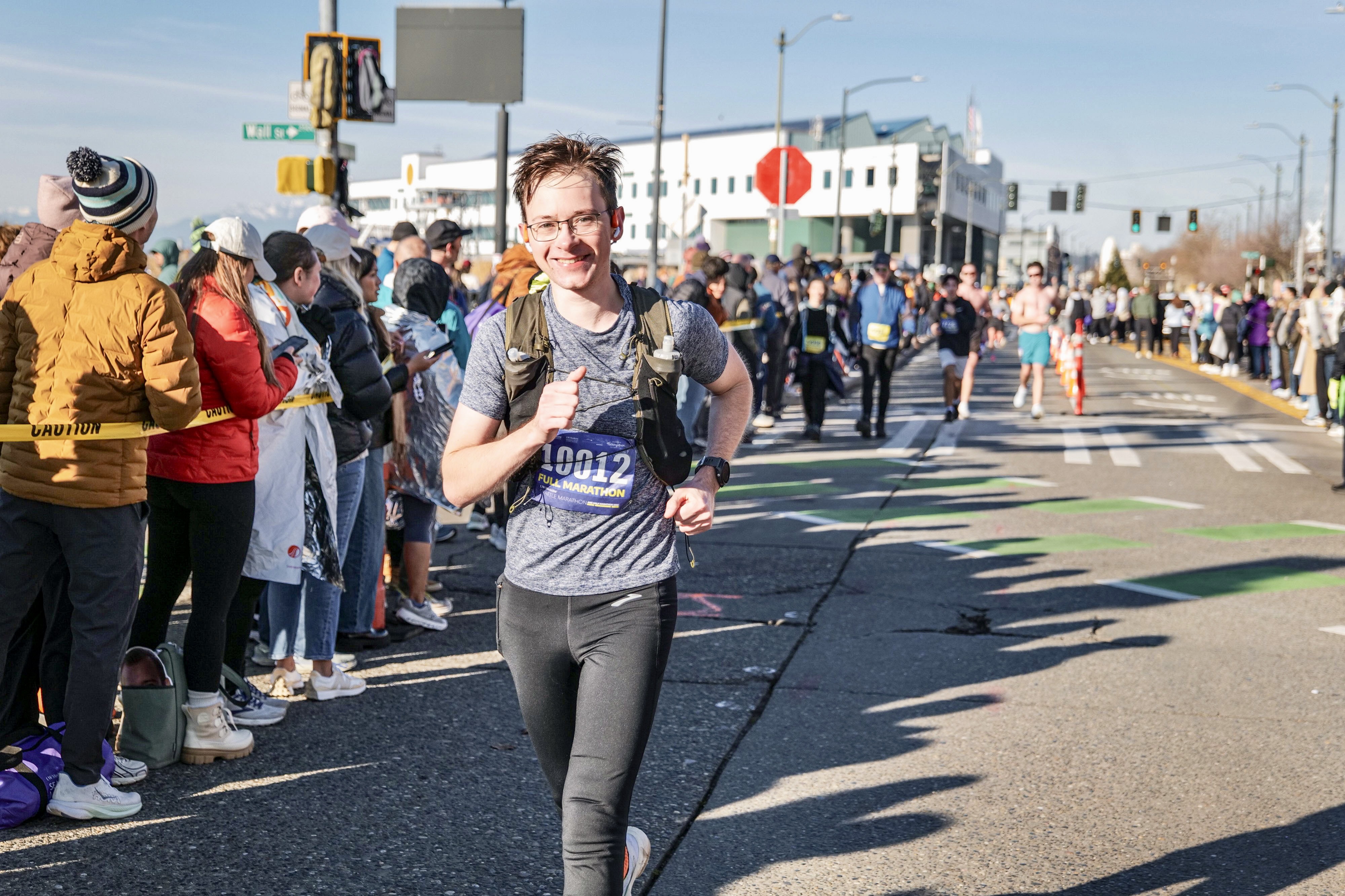
All in all, fun race. I’d do it again. :)
-
I have yet to run or bike or walk over either the 520 or I90 bridges, a glaring omission in my Seattle-native credibility. ↩︎
-
Previously, I’d just search for a reasonable internet training plan (invariably one of Hal Higdon’s plans), copy that into a spreadsheet, futz with it until it felt “right”, and then hang a printed version of that on the wall during “training season”. ↩︎
-
As a side note, RTings, better known for TV/headphone/vacuum/consumer-electronics reviews, does surprisingly good reviews for running shoes. ↩︎
-
This generalizes reasonably well to “a marathon is a $(26-N)$ mile warmup to an $N$ mile race, for values of $N >= 13$”. ↩︎