1. Slippery Ideas
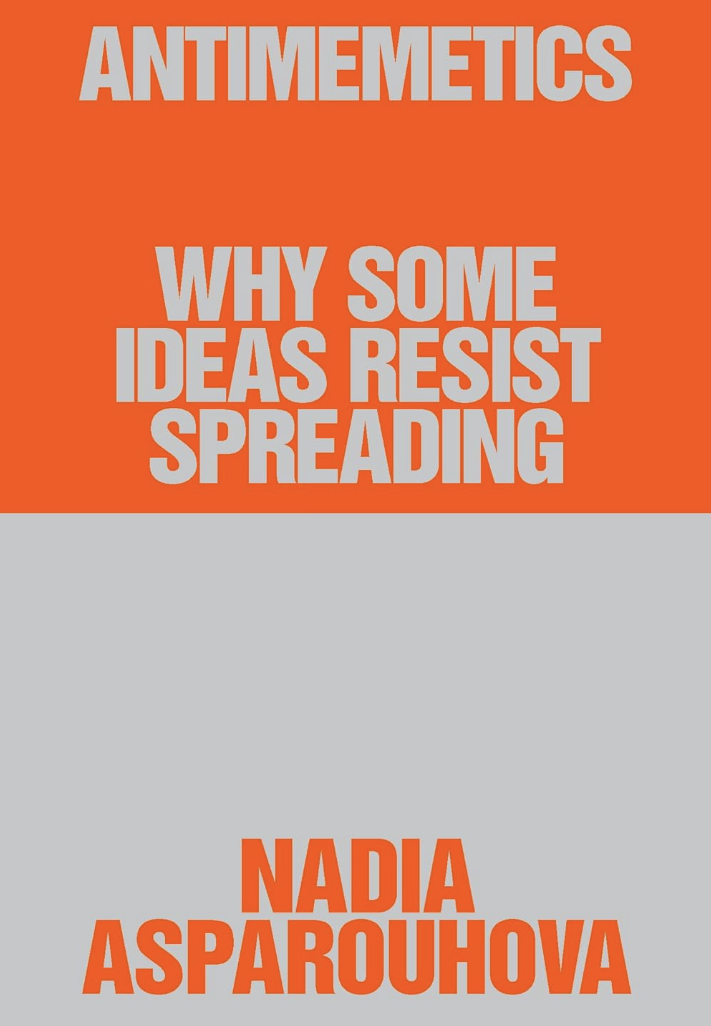
Nadia Asparouhova’s Antimemetics is, itself, antimemetic.1 I devoured this book in a few sittings on the bus to work, but if I had to describe it, I really only have a few conceptual handles that I could grasp onto:
- Memes are ideas that spread easily. Antimemes are ideas that resist spreading.
- We live in an information ecosystem which is made up of various types of memes. Memes have varying level of impact, salience, and transmissibility.
- Often the most useful ideas are antimemetic.
Here, of course, we’re talking of meme in the Richard Dawkins sense – not image macros (necessarily), but ideas that are spread through social or cultural forces. Once you see memes as such, they’re everywhere: fashions, neologisms, dances, common fears, celebrities, and so on.
2. For Lack of an Antimemetics Division
The idea of antimemes was brought to popularity by There is No Antimemetics Division, by “qntm”. It was originally a serialized novella on the SCP Wiki. The short story discusses a monster which is able to erase all memory of its existence. Researchers in the story can inspect the monster and observe it, but once they’re out of its chamber, all memory of it leaves their minds. This monster, SCP-055, is quintessentially antimemetic.
Memes want to be shared. When we come across a particularly good meme, our first instinct is to pass it on to someone else. … Antimemes are the opposite. When we encounter an antimemetic object, there is a reflexive desire – consciously or not – to suppress it.
Antimemes are slippery. They’re definitionally hard to describe, hard to share; often, they’re unsexy, uncool, and cringe.
Memes, on the other hand, want to be shared. They’re self-propagating. They’re the type of idea that has been shaped through environmental pressures into being exactly the type of thing that you want to pass on once shared, and the idea has packaged itself in such a way that it can be easily shared.
“Six-seven” is the perfect meme. There is no content to this meme, and yet it spread. Memes can be thought of as something of an inner message (the actual content), and a wrapper (the window dressing that makes it enticing to share), akin to the three-tiered hierarchy of information I’ve written about before. The six-seven meme has no inner message; it is pure wrapper. To some extent, that gives it a tremendous advantage in spreading: there is no core meaning that needs to be preserved uncorrupted.
It’s much harder to think of a quintessential antimeme. Asparouhova uses “writing your own will” as an example. Writing a will is valuable, yet most people resist doing so for years. Terms of Service are another good antimeme: they’re ubiquitously deployed, and ubiquitously ignored.
3. The Memetic Environment
Memes need a medium to spread in. Ideas have been spreading for as long as human culture has been a thing, but the development of the internet led to something of a memetic singularity. Memes can now be generated and spread, globally, at a scale unimaginable in the 20th century. Asparouhova terms this hyper-memetic environment the “memetic city”:
The memetic city is easily recognizable. It is the realm of viral ideas and social contagion: tweets that explode overnight, social media avatars supporting the latest political cause, TikToks and Instagram Reels that we scroll through at the end of a long day. Here, ideas spread with lightning speed – amplified by social platforms – and shape our collective behavior and preferences: the opinions we hold, the dates we go on, who we vote for. … [The memetic city] thrives on visibility; its power is rooted in the ability of ideas to quickly capture our attention and replicate across the hive mind.
The foil of the memetic city is the “Dark Forest”, first defined in an article by Yancey Strickler as a nod to the science fiction series of the same name. The Dark Forest theory, from the scifi series, is that in an adversarial environment, it is rational to conceal yourself, lest you be predated. In an internet overrun by spam, bots, spearphishers, SWATters, and threats of cancellation, the sane response is to retreat from the memetic city into the darker more personal corners of the web.2 Group chats, Discord servers, insular Twitter communities made up of pseudonymous posters with anime profile pictures.
Asparouhova draws heavily on Venkatesh Rao’s writing on Ribbonfarm and Maggie Appleton, both of whom I’ve quite enjoyed reading in the past. The synthesis of Rao, Appleton, and others is that a desirable response to the noise of the memetic city is a “cozy web”: “the private, gatekeeper-bounded spaces of the internet we have all retreated to over the last few years.”
Tracing a broad history of internet culture in Asparouhova’s framing goes something like: First, there was a wave of optimism that the internet could be a force for peace and connection. Second, because of forces such as mimetic desire and context collapse, the internet actually became a hostile home to culture wars. Virality, first an interesting phenomena for sharing cat pictures, became a weapon used to direct attention. Third, as a counter reaction to the previous forces, we have now entered am “antimemetic” era, characterized by a broader retreat from the town square into the dark forest.
4. Staring at an Antimeme
Descriptively, antimemes are the types of ideas that don’t work on the memetic stage. They’re not going to be a banger tweet, they won’t get you millions of likes on Instagram, they’re not “cool”.
There are different types of antimemes, since there are different reasons that ideas can resist being spread:
The Boring. Many ideas resist attention because they’re boring, unable to hold our attention for long. Terms of Service are a bureaucratic nuisance, but you click “approve” and completely forget you did so. Daylight Saving Time is briefly memetic twice per year when the clocks change, but is quickly forgotten. It just doesn’t appear important enough to fix, despite the common knowledge that roughly no one wants it.
The Taboo. Some ideas resist spread because there is a social cost of doing so. Societies use taboo as an immune response to ideas that are seen as threatening. Taboos are contextual and highly subject to opinion. These can be reasonable – such as taboos against violence – or counterproductive – such as those suppressing ideas just outside the current Overton window.
Taboos are one of the most prominent categories of antimemes… Some taboos – such as stealing, cheating, or lying – don’t budge within most networks… But taboos linger precisely because their symptomatic period is so long. They can lie dormant for years until more nodes are willing to receive or spread the idea.
The Uncomfortable. Some ideas resist being processed by our minds out of an ego-based or psychological immune response. Ideas that would be painful to process largely get ignored.
We avoid thoughts that are cognitively expensive to process… No one wants to think about their own death, much less the death of themselves and their partner simultaneously… Death, retirement planning, getting married and having kids…for many people, these ideas are difficult to prioritize because they force us to confront uncomfortable truths.
The Dangerous. Some ideas are legitimately dangerous to share The most obvious example is information related to CBRN (chemical, biological, radiological, and nuclear) weapons. However, there are some more subtle examples. Asparouhova cites Ethan Watters’ Crazy Like Us which (controversially) suggests that some mental health disorders – such as anorexia and “American-style” depression – have a component of cultural transmission, and as such information about these conditions can be dangerous to susceptible individuals. Ironically, dangerous information can be tragically memetic within vulnerable populations, such as the subreddits devoted to enabling discussions of eating disorders.
So why care? Well, to a certain type of person (*raises hand*), antimemes are fascinating. Antimemes are like going to the thrift store of ideas. Many are boring, but still interesting to look at. Some are life changing. Having a deep conversation with someone well out of your professional or social path is a great way to be introduced to novel antimemes that you can then put in your back pocket, to be explored later or forgotten, depending on the content.
Also, antimemes are often important. They’re often the “eat your veggies” of your information diet. Long reads are antimemetic, compared to a viral tweet. You may even remember the viral tweet more succinctly than a closely read long article. A good life is one not optimized for ease, but one nudged in the direction of meaning-making. Fully ignore antimemes at your own peril.
From here, Asparouhova introduces a third class of more dangerous memes that combine the “importance seemingness” of antimemes with the transmissibility of memes.
5. Supermemes
Antimemetics offers the following taxonomy of memes:
- “Memes” are highly transmission ideas with low impact.
- “Antimemes” are low transmission ideas with high impact.
- “Supermemes” are high transmission ideas with high impact.
We’ve talked about memes and their antimemetic foil, but we’ve yet to discuss supermemes:
Supermemes … are like black holes. Like memes, they spread quickly, but unlike memes, they are perceived as highly consequential. Their sheer gravitational force pulls us in, crowding out our ability to think about anything else. Whereas antimemes are characterized by a ‘strange forgetting’ by the perceiver, supermemes are characterized by a ‘strange inability to forget.’
Supermemes are akin to hyperobjects – they have some the power to totalize anything that touches them. They have the quality of a looming catastrophe, a Shepard tone of impending doom that prevents one from averting their gaze.
The obvious supermeme from 2023 until present has been AI. In my corner of the world, it’s predominantly “AI Doom”. It’s clear why: AI is scary; it portends the potential for a loss of human control; it portends the potential for the loss of human value, of human creativity, of biological intelligence. It, like climate change, is something that we appear to be doing to ourselves. We are forced to look directly at the crisis as it looms. And yet, there have been supermemes in the past. If/when we make it past our current AI doom, there will be another supermeme to replace it.
6. Truth Tellers and Champions
Finally, Asparouhova discusses the heroes of Antimemetics: truth tellers and champions. Some antimemetic ideas are worth injecting into broader awareness, and Asparouhova sees these two archetypes of people as those who have the ability to do so.
Truth tellers are willing to break social norms to say what others fear saying, often with an air of the trickster. They are often seen as cringe, and so pay a social cost.
Truth-tellers, who often operate outside of conventional norms, are especially vulnerable to being labeled as cringe. This creates a chilling effect… Cringe suppresses the truth-tellers: the chaotic, creative idiots who gleefully prod us to reassess what we think we know and believe.
Champions on the other hand, are tireless spreaders of a particular idea. If we ever eventually get rid of Daylight Savings Time, it will because someone took up the cause as a Champion and tirelessly used their energy to keep that idea salient enough for it to be addressed.
Civilization scales its cultural awareness through ‘distributed remembering,’ where we empower champions to curate our attention, which expands our ability to make progress on many different issues at once.
Society is too complex for any one person to attend to all that needs attending. Forgetting is a necessary part of living as a human, in both pre- and post-modern society. We distribute or shard our remembering, as a form of specialization. Champions take a narrow slice they feel is unattended to, and attempt to convince others to stop forgetting long enough for a problem to be solved.
7. Conclusions
What are we to make of Antimemetics? What should we hold onto as its core, while the rest slips out of memory?
I found this book hard to pin down – it’s part internet anthropology, part vibe-check of the post-2020 world, part field guide to “interesting ideas and where to find them”.
If I were to give three final thoughts:
- Occasionally force yourself to stare at antimemes. Make a log of ideas you run into. Sure, forget most of them, but build the muscle nonetheless. Find one or two ideas to champion to an unreasonable degree.
- It’s reasonable to incubate ideas in private cozy-web style environments before deciding whether to share them more publicly. Doing so is psychologically and socially well-adapted.
- Developing good “cognitive security” is already a baseline requirement for being sane in the post-modern world. This will only become more of a necessity with the increase of generated media. Generative AI is another step change in the ability for memes to evolve for reproductive fitness faster, so we should expect more captivating memetic spread in the next few years.
-
Under the book’s framing, I think this is a compliment? ↩︎
-
Anyone who has had a post go even semi-viral, I think, can feel the appeal of the dark forest. When one of my posts gets picked up on Hacker News, there’s this feeling of the Eye of Sauron being cast upon you. Something, somthing “Don’t read the comments.” Even if most of the feedback is positive, there’s a chilling effect and set of expectations that comes with this. – A temptation to sand off the edges of ideas to make them more palatable, or to offer fewer handles for criticism. I don’t think this phenomena of attention warping is new to the internet, but the ability to link/screenshot/amplify anything hypercharges it. Sharing a random half-baked idea in a private Discord group has an effectively zero chance of blowing up on you. Sharing a half baked idea on X/Twitter also has an effectively zero chance of blowing up on you, but it creates an ~immutable, searchable public record of your half-baked idea, which can be trawled up years later by someone fishing for dirt. ↩︎