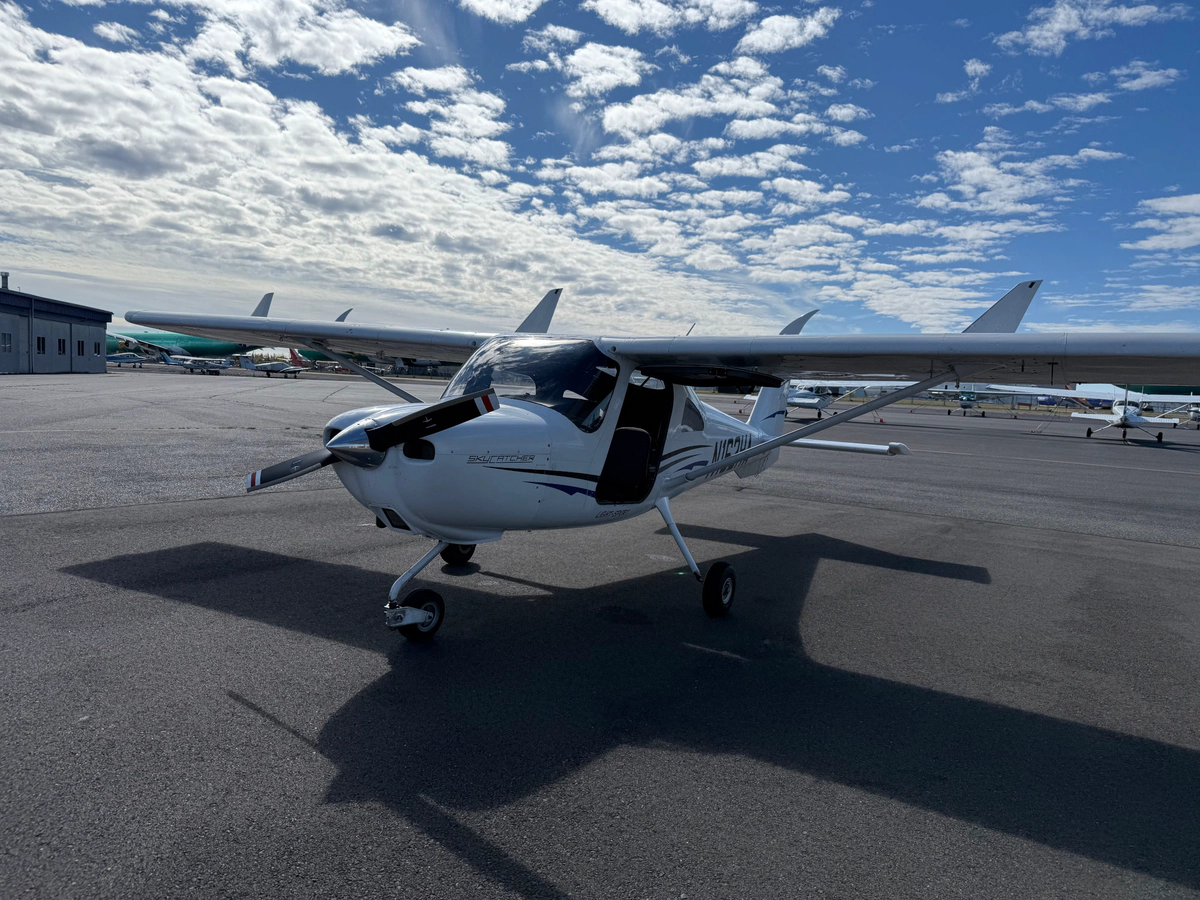
I’m about half a dozen flights into training for a Private Pilot’s License and wanted to write some notes while I’m still firmly in the “beginner mindset”.
𐡸 Flight training has tons and tons of mnemonics. Wikipedia has 2 separate articles for these (1, 2), and this is nothing near an exhaustive list. Many of these mnemonics are either heavily forced acronyms (e.g. for landing go arounds: CCCC = “cram it, clean it, cool it, and call it”) or somewhat opaque phrase (e.g. for takeoffs, “lights camera action”: lights indicates setting lights, camera indicates setting your transponder, action indicates items like setting your mixture). The result is that mnemonics are helpful only insofar as you internalize what they actually mean. I recently learned a helpful mnemonic for rudder control – “step on the ball” – which helps you remember which way to control the rudder to maintain coordinated flight. In this case “the ball” refers to the inclinometer in analog flight instrument panels, which slides to the side of the turn that is uncoordinated. You “step on the ball” to force it back to the center. However, I took this a little too seriously and would step hard in the direction that the mnemonic indicated, resulting in over-yawing.
Like learning any skill, you want to push yourself just outside your comfort zone so that you’re learning, but not so far outside your comfort zone that you get overwhelmed. The first couple times I did takeoffs, just the feeling of taking off and managing the initial climb was overwhelming. You have to manage your pitch, throttle, rudder coordination, and where I fly, near KBFI, be careful not to over-climb into SeaTac’s Class B airspace.
This has gotten better, to the point where takeoffs themselves are not overwhelming and I’m often (but not always) able control the plane solo during takeoff. Recently I’ve started traffic pattern practice, and that is a whole other set of things to learn and manage: more precise turns, speed management, flaps, radio calls, and landings.
𐡸 Getting a quality flight headset was worth the expense. The first few flights I took, I used the cheaper rental headsets that my flight school stocks. These had pretty strong clamping force and the noise isolation wasn’t great – both of which gave me headaches after flying. I spent the ~$600 for a refurbished Lightspeed Sierra headset, which has active noise cancelling, and never had a headache again.
𐡸 Being bad at a beginner at something is surprisingly fun. There is a
lot to learn: checklists, procedures, mnemonics, muscle memory, communication
patterns, how to listen to ATC, how to listen to the automated weather reports,
how to operate the flight displays and radios, and so on. Each time I go out, I
feel like my brain gets fried with the amount of information it receives. The
hours after flight lessons are when I feel the most mentally taxed of the entire
week – weeks that also include long focused coding sessions, incident
war-rooms, back-to-back meeting marathons, and strenuous long runs. There’s
something about the calibrated mental overwhelm of learning new skills and
knowledge way outside one’s normal domain that is uniquely taxing, but in a way
that’s also quite generative.
𐡸 The “flight loop” has a surprising amount of satisfying routine. My brain lives for this sort of stuff. Every preflight inspection is an opportunity to geek out on the mechanics of how a plane works. Running through checklists while pointing to each item as I perform it is mechanical in a way that is deeply satisfying. You spend a lot of your time thinking and talking about and practicing what happens if something goes wrong. It turns out that a methodical focus on safety and reliability isn’t something that I value just in software systems.
𐡸 The Pacific Northwest is beautiful from the sky. On my discovery flight a few months ago, I had nearly perfect weather and got to fly out to Bremerton and back, over Puget Sound. In subsequent flights, I’ve not had quite as good visibility and have had more winds, but even so, seeing Seattle from the skies feels like a treat each time I go up. So far, I’ve gotten to fly over Lake Washington and Lake Sammamish, and over to Maple Valley. I’m looking forward to the summer, when visibility and general conditions improve again, but for now, even an overcast VFR flight still feels fresh and exciting. I’m seeing the place I’ve spent most of my life from a new perspective.